Pain on the outside of your elbow can make gripping a racquet, lifting a pan, using a mouse, or turning a tool difficult, but complete rest rarely rebuilds the arm’s capacity. By the end, you will know how clinicians identify lateral elbow tendinopathy, how exercise is progressed, how to adjust daily and tennis loads, and when another treatment or diagnosis needs consideration.
Key takeaways
- Confirm the diagnosis before treating outer-elbow pain as tennis elbow.
- Progress from isometric exercises to strengthening as pain and capacity improve.
- Reduce painful gripping and lifting loads without stopping all arm movement.
- Return to tennis when strength, tolerance and sport-specific tasks are controlled.
Is the Pain Really Tennis Elbow? Start With the Right Assessment
Pain at the bony outer elbow that increases with gripping or lifting is consistent with tennis elbow, more accurately called lateral elbow tendinopathy. The common extensor tendon, particularly the extensor carpi radialis brevis (ECRB), is loaded when you extend the wrist or fingers against resistance.
A physiotherapist tests these actions, checks grip strength against the other side, and asks about work, racquet use, tools, and recent changes in training volume.
| Condition | Clues | Assessment focus |
|---|---|---|
| Lateral elbow tendinopathy | Local outer-elbow pain with gripping, resisted wrist or finger extension | Palpation, resisted tests, grip comparison, functional loading |
| Neck-related nerve-root pain | Pain travels from the neck or shoulder; tingling, numbness, or weakness may occur | Neck movement, nerve tension, reflexes, sensation, and myotomal strength |
| Radial tunnel syndrome | Deeper aching in the upper forearm, often aggravated by resisted supination or middle-finger extension | Radial-nerve examination and motor testing; sensory loss is not typical |
| Acute elbow injury | Pain begins after a fall, blow, forceful twist, or sudden event; swelling or restricted movement may follow | Trauma history, joint movement, stability, and fracture or dislocation signs |
A neck screen and examination of the shoulder and elbow joint help prevent tendon pain being assumed too quickly. Numbness, marked weakness, major loss of movement, deformity, fever, or substantial trauma requires prompt reassessment. Ultrasound or MRI is not routinely needed for an uncomplicated case, but becomes useful when symptoms are severe, persistent, or atypical.
Which Exercises Rebuild Wrist and Forearm Capacity?
Wrist-extensor loading forms the core: begin with pain-limited wrist-extensor isometrics, then build toward controlled resistance that matches your work or sport.
| Exercise | What it develops | Typical starting approach |
|---|---|---|
| Wrist-extensor isometrics | Tolerance and short-term pain control | Hold a neutral wrist against resistance for 30–45 seconds, 4–5 times |
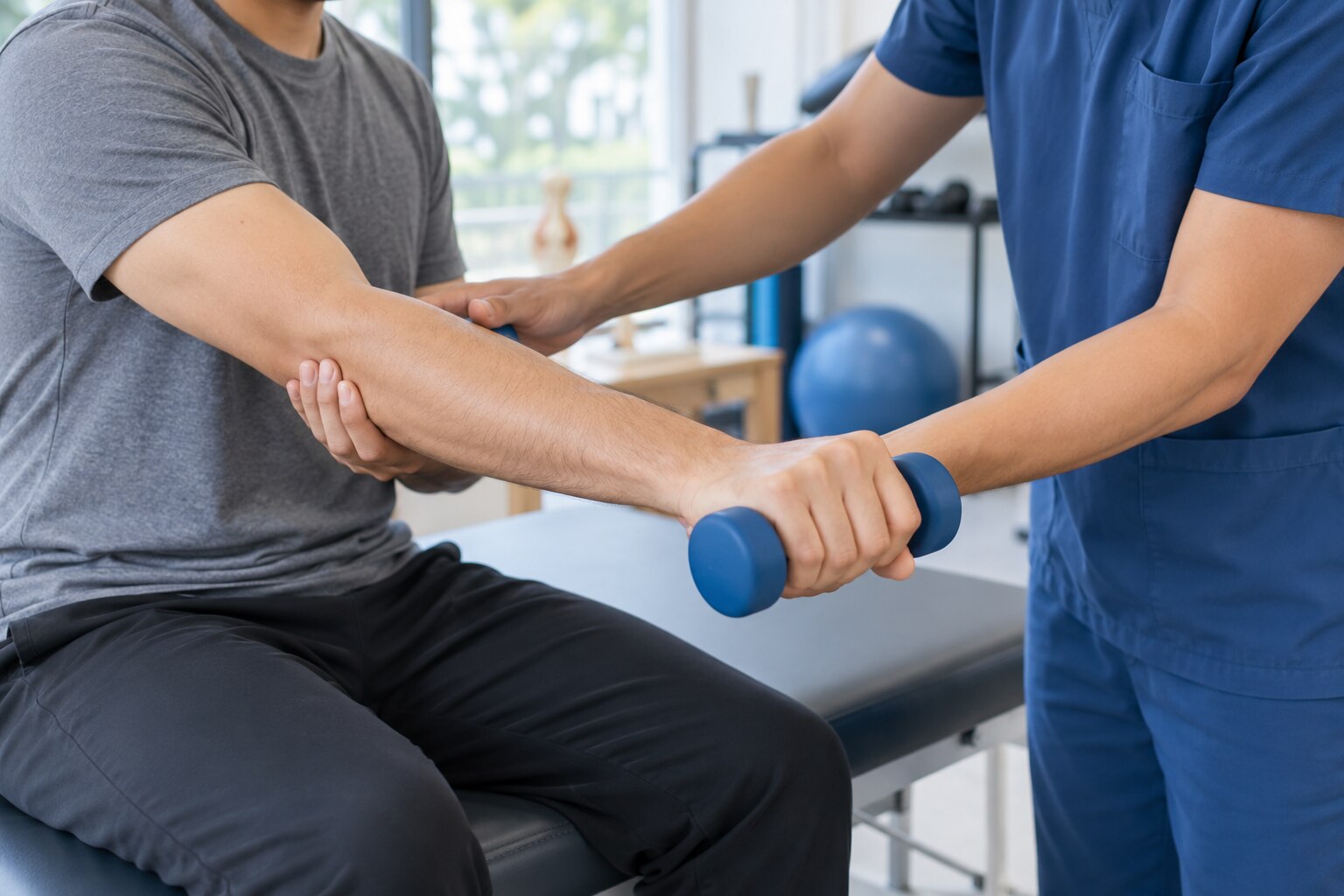
| Concentric-eccentric loading | Extensor strength through movement | Use a light dumbbell for 2–3 sets of 8–12 slow repetitions |
| Forearm rotation | Control for racquet, tool, and lifting tasks | Rotate a hammer or light weight through a comfortable range |
| Grip strengthening | Capacity for gripping and carrying | Squeeze a soft ball or dynamometer without provoking a sharp flare |
A physiotherapist chooses resistance that permits controlled movement and keeps symptoms acceptable, commonly around 0–3 out of 10 during exercise. The exact load depends on irritability, current strength, and daily demands; no single eccentric-only programme suits everyone.
Train three or four days per week, with rest between demanding sessions. Progress when you complete every repetition with steady technique, pain returns to its usual level by the next morning, and gripping or work tasks are not deteriorating. Increase one variable at a time: resistance, repetitions, range, speed, or task complexity.
- Reduce the load, volume, or frequency when pain remains substantially worse the following day.
- Keep isometrics as a symptom-management tool, not the entire programme.
- Add tennis-specific gripping, wrist extension, and forearm work as basic exercises become easier.
How Do You Reduce Irritating Loads Without Stopping All Movement?
Complete rest often makes ordinary loading feel harder when you resume it. Load management means reducing the dose of the activity that provokes pain while keeping the elbow, wrist, and shoulder moving within a tolerable range.
- Tennis: cut court time, serving volume, or high-force backhands before abandoning the sport. A racquet modification such as a larger grip, lighter frame, or lower string tension can reduce demand; check changes with a coach if technique is contributing.
- Gripping and lifting: keep your grip firm enough for control, not clenched. Use a neutral wrist, hold loads close to your body, and lift with the palm facing sideways rather than repeatedly lifting palm-down.
- Mouse use and tools: support your forearm, keep the mouse close, change position regularly, and choose tools with larger handles. Take brief movement breaks before discomfort builds.
- Domestic tasks: divide shopping, gardening, cooking, and cleaning into shorter bouts. Use both hands, alternate tasks, and avoid prolonged wringing or forceful squeezing.
A tolerable response should settle by the following day and should not reduce your grip or work ability. If pain remains substantially worse, reduce duration, force, speed, or frequency instead of stopping every movement.
Rebuild capacity by increasing one variable at a time, then progress your return to tennis from easy hitting to longer sessions, harder strokes, and serving.
How Should Exercise Compare With Braces, Medication, Injections, and Shockwave?
Exercise should be the foundation because progressive resisted wrist-extensor loading rebuilds tolerance for gripping and sport. Braces, medication, injections, and shockwave can reduce symptoms or assist a specific stage, but none replaces gradual loading and task modification.
| Option | What it helps with | What it leaves unaddressed |
|---|---|---|
| Exercise | Restores strength, tendon capacity, and workload tolerance | Progress can take months and symptoms may fluctuate |
| Counterforce strap | Reduces pain during gripping or a particular activity | Does not rebuild capacity or correct technique |
| Wrist-extension splint | Limits painful wrist extension during work or sleep | Prolonged reliance can delay normal loading |
| Medication | Short-term pain relief that may help you stay active | Does not repair capacity; side effects and overuse matter |
| Corticosteroid injection | Rapid short-term pain reduction | Higher recurrence and poorer longer-term results can follow; it does not restore load tolerance |
| Platelet-rich plasma (PRP) | An injectable option intended to influence persistent symptoms | Evidence is inconsistent, and preparation and dose vary; superiority over exercise is unproven |
| Shockwave | May reduce persistent pain in selected cases | Results vary, and it does not replace strengthening or workload progression |
Common mistakes make recovery harder: using a strap to continue the same excessive gripping, stopping exercise once pain eases, or judging treatment by immediate comfort rather than grip strength, function, and next-day response. Isometrics can be a useful entry point, while progressive concentric and eccentric loading remains the longer-term target.
Painkillers or an injection that enables a sudden return to full tennis can mask overload rather than solve it.
What Does a Safe Return to Tennis and Normal Work Involve?
Expect progress over months, not a straight line from pain to full play. Judge the rehabilitation timeline by trends in pain, grip strength, work tolerance, and tennis workload rather than by whether the elbow feels normal after every session.
Use these checkpoints before increasing activity:
- You complete your current exercises with controlled movement and no escalating pain.
- Your next-day response is close to baseline; a clear flare lasting into the following day means the recent load was too high.
- Grip strength and practical tasks, such as lifting a pan or using a mouse, are improving.
- You can repeat the workload without losing function at work or during daily activities.
A graded return to sport starts with shorter sessions, reduced pace, and fewer serves. Rebuild serving by adding gentle flat serves before repeated high-speed or spin serves; test backhands with cooperative feeds before full-power rallies and competitive play. Increase one variable at a time, such as duration, intensity, or number of shots.
If symptoms rise substantially, reduce resistance, repetitions, speed, or frequency rather than stopping all movement. A physiotherapist can match these changes to your job, racquet technique, and strength testing.
PhysioFirstt may be useful when progress has stalled, next-day symptoms remain unpredictable, or you need objective grip and workload benchmarks for returning to tennis and normal work.
Related services
Physiotherapy Physiotherapy Restore your strength, mobility, and quality of life with professional physiotherapy services tailored to your needs. |
Sports Rehabilitation focuses on the prevention, assessment, treatment, and recovery of sports-related injuries. View service → |
Frequently asked questions
How can you tell whether outer-elbow pain is really tennis elbow?
Assessment considers pain location, gripping and lifting symptoms, wrist and finger resistance, elbow movement, neck involvement and other possible causes.
Which exercises help rebuild wrist and forearm capacity?
A graded programme can progress from pain-limited isometric contractions to wrist extension, forearm rotation, gripping and sport-specific strengthening.
Do you need to stop all movement with tennis elbow?
No. Reduce or modify the loads that sharply increase symptoms while keeping comfortable movement and gradually rebuilding tolerance.
How does exercise compare with braces, medication, injections and shockwave therapy?
Exercise and load management address strength and capacity, while braces, medication, injections and shockwave therapy have different roles, limits and risks.
When can you return to tennis and normal work?
Return when daily tasks and tennis movements are controlled, symptoms remain settled after loading, and strength and endurance have been rebuilt progressively.