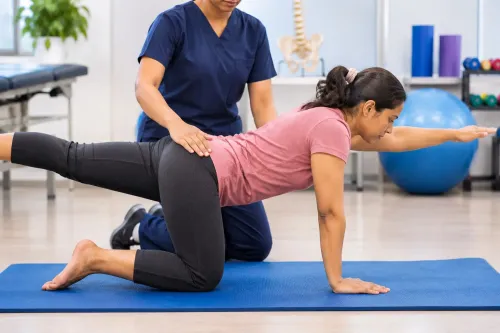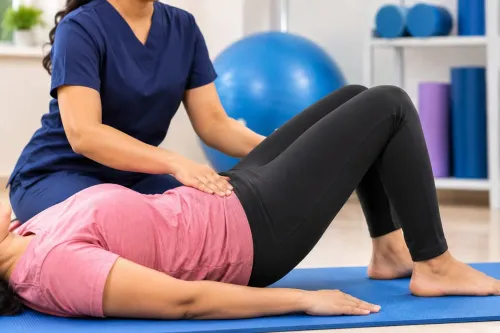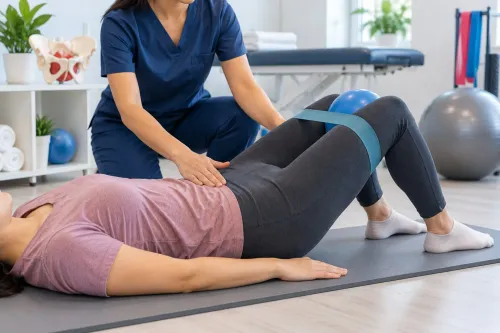
Unsteadiness while walking can come from weak ankles or hips, painful joints, poor stepping reactions, vestibular problems, medication effects, vision changes, or neurological impairment. By the end, you will understand how clinicians identify the limiting factor, how exercises are progressed, and how balance practice translates to stairs, pavements, turns, and crowded spaces.
Key takeaways
- A balance assessment identifies whether pain, weakness, sensation or timing affects your walking.
- Targeted exercises train weight shifting, stepping, turning and recovery after balance loss.
- Practise balance near stable support and track turning, walking and confidence changes.
- Seek assessment when unsteadiness persists, worsens or interferes with daily activities.
What a Balance Assessment Reveals About Unsteady Walking
A balance rehabilitation assessment identifies the source of unsteadiness by comparing how you stand, shift your weight, step, turn and recover from a sudden loss of balance. A clinician also checks whether pain, weakness, sensory loss, poor timing or a medical condition changes those responses.
The examination may include:
- Strength testing: weak ankles, hips or trunk can delay foot placement and reduce the force needed to catch yourself.
- Pain and joint movement: knee, hip, ankle or spinal pain can make you avoid loading one side or shorten your steps.
- Sensory testing: reduced feeling in the feet or nerve impairment can make balance worse when you cannot see where your feet are.
- Vision and vestibular checks: blurred vision, head movement or an inner-ear problem can disrupt orientation and turning.
- Coordination and reaction testing: slow step timing, inaccurate foot placement or difficulty following a sequence points to impaired motor control.
- Medication and medical review: sedatives, blood-pressure drugs, dizziness on standing and neurological disease can contribute to falls.
Standing balance on a firm, well-lit floor does not tell the whole story. The clinician may repeat weight shifting and a gait assessment on a softer surface, in dimmer light, during head turns, around obstacles and while changing speed.
These conditions expose sensory conflicts and reveal whether you can recover from a trip, rather than merely remain still. Persistent or sudden worsening warrants medical assessment alongside rehabilitation.
How Exercises Improve Stability, Coordination and Walking Control
Standing still is only one piece of walking control. Exercises improve stability by narrowing your base, shifting your centre of mass, strengthening weight-bearing legs, and forcing quick, accurate steps when your balance changes.
| Exercise | Main ability trained | Walking benefit |
|---|---|---|
| Tandem stance | Narrow-base stability and ankle control | Keeps you upright when your feet pass close together |
| Single-leg support | Weight transfer and hip control | Improves foot clearance and stance on one leg |
| Sit-to-stand practice | Leg strength, forward weight shift and movement timing | Supports safe transfers and the first steps after rising |
| Step-ups | Leg power, foot placement and step timing | Builds the ability to climb, clear obstacles and recover from a misstep |
| Reaching tasks | Trunk control and centre-of-mass movement | Helps you lean, turn or reach without stepping unpredictably |
Strengthening alone is not balance rehabilitation. A stronger leg does not guarantee accurate foot placement or a fast response to a trip, so practice adds stepping, turning, changes of speed and controlled balance challenges.
A clinician can progress from supported tandem stance to less hand support, longer holds and walking along a narrow path. Single-leg support may become step-and-hold drills, while reaching tasks can require you to recover after moving outside your usual base. These graded challenges build coordination and confidence without demanding perfect symmetry.
For dizziness linked to a vestibular disorder, gaze-stabilisation and habituation exercises need individual prescription rather than generic balance drills.
How Balance Practice Transfers to Everyday Walking
Rehabilitation transfers to everyday walking by changing one demand at a time, then combining demands when you can respond without losing control. A clinician may begin on a firm, well-lit floor with hand support available, then reduce support, narrow your steps, increase walking speed, and add turns or sudden stopping.
Progression commonly includes:
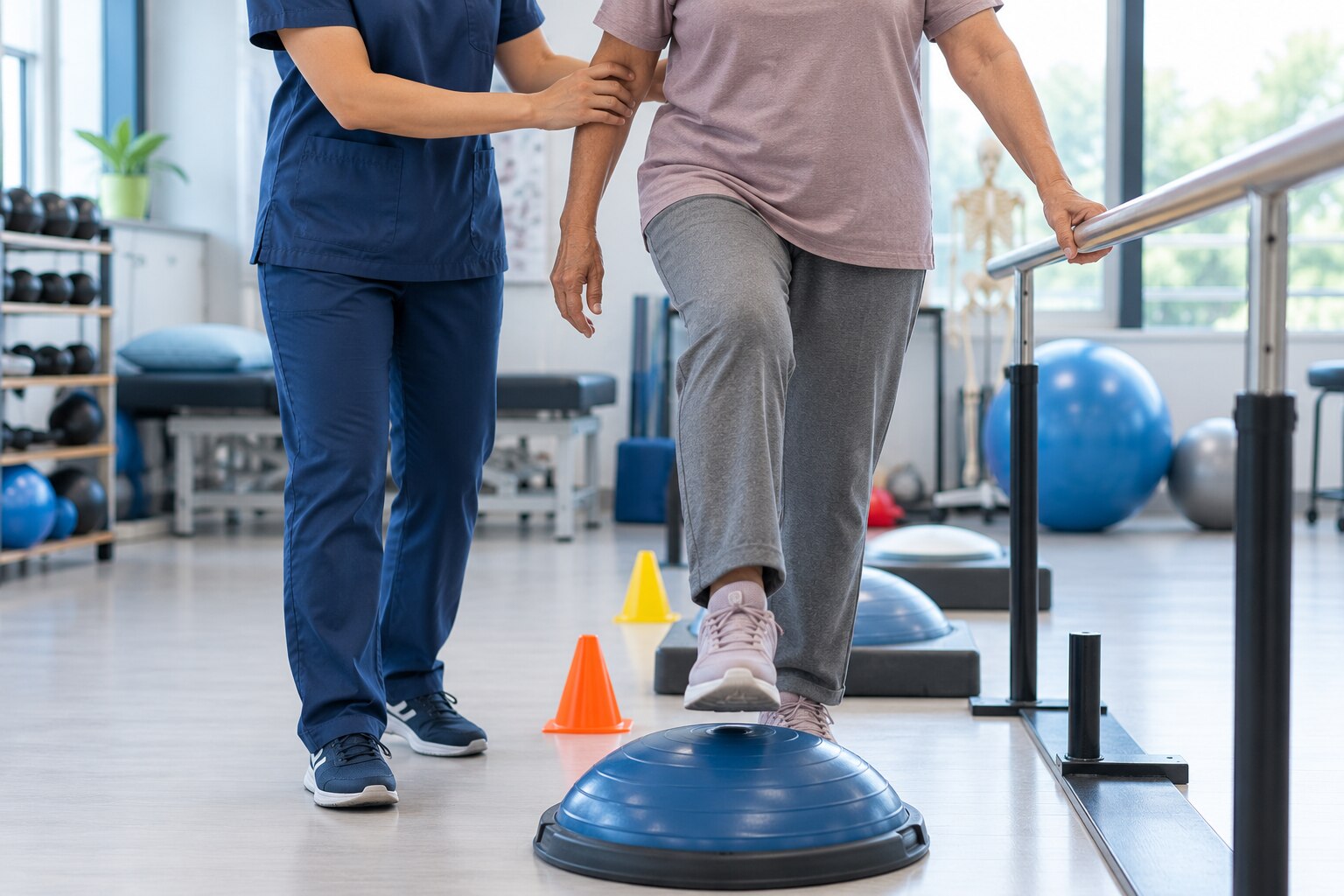
- Stepping over low objects, around cones, and through narrow spaces to practise obstacle negotiation without catching your toes.
- Walking up and down stairs, starting with a rail and deliberate foot placement before increasing speed or reducing hand support.
- Crossing foam, mats, gravel-like surfaces, or uneven pavements to challenge the sensory information your feet provide.
- Walking in dim light, where reduced vision makes foot placement and balance reactions more important.
- Turning your whole body, changing direction, and walking while turning the head to prepare for checking traffic or looking at a shop shelf.
- Carrying a light object, then managing dual-task walking by talking or answering a simple question while moving.
These tasks expose the difference between standing steadily and recovering from a misstep. The clinician increases distance, speed, unpredictability, or cognitive load only when you can step safely rather than stiffen, reach for support, or stop abruptly.
Community mobility practice may then include doorways, kerbs, crowded paths, and mixed surfaces. The aim is adaptable walking, not a perfect performance on one clinic test.
When Balance Rehabilitation Is the Right Next Step
Choose balance rehabilitation when your main problem is unsafe or poorly adaptable walking: misplaced feet, delayed stepping, difficulty turning, losing balance when reaching, or fear that changes how you move. It is more specific than a general home exercise programme because the exercises are progressed against the task that fails.
| Option | Best fit | Limitation or next step |
|---|---|---|
| Balance rehabilitation | Walking instability, poor coordination, weak balance reactions, or low confidence | Needs assessment and progression; it is not a substitute for medical diagnosis |
| Home exercise programme | Mild, understood deficits with safe space and reliable follow-through | Unsupervised practice can repeat errors or miss hazards |
| Walking aids | Immediate support for distance, transfers, or outdoor safety | A stick or walker does not restore balance reactions; it must be fitted and used correctly |
| Strength-only training | Clear weakness limiting sit-to-stand, stairs, or stepping | Stronger muscles alone do not train weight shifting, foot placement, or recovery steps |
| Vestibular rehabilitation | Dizziness, vertigo, or head-movement sensitivity linked to the vestibular system | It does not cover every gait or strength problem |
| Occupational therapy | Difficulty managing dressing, bathing, kitchen tasks, transfers, or home hazards | It complements rather than replaces walking-focused practice |
| Medical assessment | Sudden change, fainting, new weakness or numbness, severe dizziness, progressive disease, or medication effects | Treat the cause before relying on exercise |
PhysioFirstt can be useful when you need the choice narrowed through movement testing rather than guessing between strength work and balance practice. Ask what finding supports the plan, how walking safety will be measured, and when a medical referral is needed.
Related service
Physiotherapy Physiotherapy Restore your strength, mobility, and quality of life with professional physiotherapy services tailored to your needs. |
How to Practise Safely and Track Real Progress
Practise beside a stable support, not by gripping it throughout every exercise. Holding on too tightly hides poor balance; staying at an easy level indefinitely prevents adaptation, while rushing, training when fatigued, or ignoring dizziness increases risk. Fear of falling can also reduce activity, slow your walking, and erode conditioning.
- Clear loose rugs, improve lighting, wear secure footwear, and keep your walking aid within reach. These are fall prevention measures, not optional extras.
- Use a chair, rail, or trained helper for challenging tasks, then reduce support only when you can complete them without grabbing or losing control.
- Progress one demand at a time: narrower foot position, less hand support, larger or faster steps, turns, obstacles, reduced predictability, or carrying and talking.
- Stop for chest pain, faintness, new severe dizziness, unusual breathlessness, or repeated near-falls. Arrange medical review rather than pushing through these symptoms.
Judge progress in real walking tasks. Record how often you touch a support, stop, misplace a foot, or need help on turns, stairs, uneven ground, low light, and while carrying an object. Note whether you recover from a trip with a step instead of freezing.
Measure confidence separately. The Activities-specific Balance Confidence Scale and Falls Efficacy Scale-International can track fear of falling and activity avoidance; pair their scores with walking observations. Stronger legs or a better single balance score do not prove safer community mobility. Progress means safer, more adaptable walking with fewer restrictions.
Frequently asked questions
What does a balance assessment reveal about unsteady walking?
It compares how you stand, shift weight, step, turn and recover from a sudden loss of balance. The clinician also checks pain, weakness, sensory loss, poor timing and medical factors.
How do balance exercises improve walking control?
Exercises practise weight shifting, stepping, coordination and balance recovery so your body can respond more effectively while standing and walking.
How does balance practice transfer to everyday walking?
Practice can focus on tasks such as turning, changing direction, stepping over obstacles and recovering from small disturbances, which helps connect exercises with daily movement.
When is balance rehabilitation the right next step?
Consider an assessment when unsteadiness continues, affects walking confidence or limits everyday activities. Seek prompt medical advice after a sudden or severe change in balance.
How can you practise balance safely and track progress?
Use stable support, remove trip hazards and follow exercises suited to your ability. Track walking distance, turning control, near-falls and confidence over time.