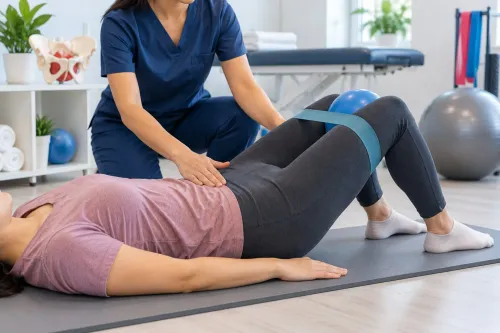

Leg pain, numbness, or weakness after a back injury does not automatically mean you need complete rest or surgery. You will learn how clinicians match symptoms and neurological findings to movement, exercise, and daily-task progression, while recognising when symptoms need urgent medical review.
Key takeaways
- Assessment checks nerve symptoms before exercise begins.
- Choose movements by tracking how leg pain responds.
- Build strength through graded exercises and everyday tasks.
- Review worsening symptoms or stalled progress with your clinician.
How is a suspected slipped disc assessed before exercise begins?
A slipped disc assessment starts with the pattern of symptoms, not an MRI report. “Slipped disc” usually means lumbar disc herniation, where disc material irritates a nerve root and causes back pain travelling into the buttock or leg. The clinician also considers hip problems, sacroiliac pain, spinal stenosis, muscle injury and other nerve conditions.
1. Ask when the pain began, where it travels, and whether coughing, sitting, walking or bending changes it. Record numbness, pins and needles, sleep disruption, walking limits and work difficulties.
2. Test leg strength, sensation and reflexes. Weak ankle lifting, reduced knee or ankle reflexes, or altered sensation can support nerve-root involvement and show whether neurological loss is progressing.
3. Use movement testing and, when appropriate, a straight-leg raise or slump test to check whether spinal or nerve tension reproduces the familiar leg symptoms. A painful back movement alone does not prove disc-related pain.
4. Screen urgently for new bladder or bowel dysfunction, saddle numbness, or severe or worsening weakness. These findings need urgent medical assessment rather than routine exercise treatment.
An MRI can show a disc bulge, protrusion or extrusion without causing symptoms. The disc protrusion and extrusion difference describes how far the disc material extends, but neither label decides treatment; compare the image with symptoms, examination findings and function.
Imaging is useful when its result could change management, not as a substitute for clinical reasoning.
How are movements chosen when leg pain is present?
Leg pain determines which movement you start with, how far you take it, and whether you keep it. There is no universal movement for slipped disc symptoms.
A physiotherapist watches whether symptoms retreat towards the back or spread farther into the buttock, thigh, calf, or foot, then uses that response to choose a starting position and direction.
A clinician may compare:
- A position that eases leg pain is retained as a comfortable starting point; one that sends symptoms farther down the leg is changed or avoided.
- Repeated movement testing uses several repetitions in one direction to check whether symptoms become less intense, move closer to the spine, or worsen.
- Walking with sciatica starts at a tolerable duration and pace, then increases only when it does not produce a lasting flare.
- Gentle mobility exercises keep movement within a comfortable range when bending or extending fully is too provocative.
A brief increase in symptoms does not automatically mean new disc damage, but symptoms that progressively travel farther down the leg or fail to settle after exercise require reassessment. New or worsening weakness also needs medical review. The right programme improves movement and daily function without leaving you worse for the rest of the day.
Which exercises build strength and restore everyday capacity?
Strength and everyday capacity return through graded loading, not a single exercise; slip disc exercises must match the task you need to regain. Trunk stabilisation, hip and leg strengthening, neural mobility exercises, and aerobic work each address a different limitation.
| Exercise category | Start | Progression | Daily goal |
|---|---|---|---|
| Trunk stabilisation | Bracing, bridges and controlled limb movements; 6–10 repetitions | Add repetitions, then resistance and harder positions | Sitting and lifting |
| Hip and leg strengthening | Sit-to-stands, step-ups and hip work | Add repetitions, resistance, step height and single-leg control | Stairs and squats |
| Neural mobility exercises | Gentle sliders through a comfortable range; 5–10 repetitions | Increase range or sets only when symptoms settle | Walking and sitting |
| Aerobic conditioning | A tolerable walking interval, such as 5–10 minutes | Add walking time before speed or hills | Endurance |
| Functional loading | Hinging, lifting and carrying with a light load | Increase load, distance, speed and task complexity | Work or sport |
Use symptoms and function to set the dose: add repetitions before resistance, resistance before speed, and range only when movement stays controlled. Mild effort is acceptable, but leg pain that travels farther, new weakness, or symptoms that fail to settle after exercise requires reassessment.
Track walking time, sitting tolerance, lifting ability, sleep and confidence alongside pain. Progress means doing more safely, even when some back or leg discomfort remains.
How do you know whether rehabilitation is helping or needs review?
A useful programme leaves you moving more easily over time, even if an exercise causes brief, manageable back or leg discomfort. The key distinction is exercise discomfort versus warning signs: symptoms should settle after reducing the dose, changing position, or resting briefly, not intensify with every session.
Stop the exercise and arrange reassessment if you develop:
- Pain or tingling that progressively travels farther down the leg
- New or worsening progressive weakness, such as the foot slapping or the knee giving way
- Numbness that does not settle after exercise
- New bladder or bowel difficulty, saddle numbness, or severe weakness
Common mistakes include pushing through spreading nerve symptoms, increasing repetitions and resistance together, stopping all activity for days, and judging progress by pain alone. Prolonged bed rest can reduce strength and confidence; track walking time, standing tolerance, sleep, and daily tasks instead.
Conservative care can include prescribed medication, self-management, graded exercise, and an epidural injection for sciatica when a clinician considers it appropriate. Osteopathy may complement rehabilitation if treatment remains consistent with the neurological findings.
The physiotherapy versus surgery decision changes when weakness progresses, cauda equina symptoms appear, or pain and function fail to improve despite suitable non-surgical care. For persistent sciatica, decompression may be considered when imaging matches the symptoms and surgery could improve pain or function.
How does functional rehabilitation prepare you to return to work, lifting, or sport?
Progress is measured by what your back and leg can do, not by pain intensity alone. A clinician may record walking tolerance, sitting time, lifting capacity, sleep, neurological strength and sensation, confidence with movement, and the demands of your job or sport. Some discomfort can remain while function improves.
- Set a baseline. Record how far you walk, how long you sit, and which work, lifting, or sporting tasks currently fail.
- Break the task down. Functional rehabilitation for slipped disc may start with hip hinging, carrying a light object, or repeated sit-to-stand practice before full-duty loading.
- Rebuild capacity gradually. Increase weight, repetitions, range, distance, speed, or practice time one variable at a time. A graded plan for lifting after disc herniation teaches you to brace, hinge, hold the load close, and turn with your feet.
- Test the real demand. Return to work after sciatica requires practice that matches your shift length, driving, floor-level work, or repeated lifting. Return to sport rehabilitation adds running, jumping, cutting, throwing, or sport-specific fatigue.
- Set readiness rules. Progress when symptoms settle between sessions, strength and control remain reliable, and the task no longer causes spreading leg pain or worsening weakness.
PhysioFirstt can use these task measures to adjust exercise dosage rather than stopping when symptoms first ease. If leg symptoms travel farther downward, weakness develops, or an increase fails to settle, pause the progression and seek reassessment.
Related service
Physiotherapy Physiotherapy Restore your strength, mobility, and quality of life with professional physiotherapy services tailored to your needs. |
Frequently asked questions
How is a suspected slipped disc assessed before exercise begins?
A clinician reviews your pain pattern, strength, sensation, reflexes and movement. They also consider hip, sacroiliac, spinal stenosis, muscle and other nerve conditions.
How are movements chosen when leg pain is present?
Choose movements based on how symptoms respond during and after exercise. Stop and seek review if leg pain spreads, weakness increases or numbness worsens.
Which exercises build strength and restore everyday capacity?
A rehabilitation plan can progress from comfortable movement and trunk control to hip, leg and whole-body strengthening, then task-specific practice.
How do you know whether rehabilitation is helping or needs review?
Improvement shows through reduced leg symptoms, better movement, stronger muscles and greater tolerance for daily tasks. Request review if symptoms worsen or progress stalls.
How does functional rehabilitation prepare you to return to work, lifting or sport?
It gradually rehearses the demands of your role or activity, including bending, lifting, carrying, running or changing direction, while increasing load safely.