An ankle sprain can heal enough for ordinary walking while still leaving the joint weak, stiff, or prone to giving way. By following the right progression—from swelling control and mobility work to strength, balance, hopping, and sport-specific loading—you can track whether the ankle is regaining useful function rather than relying on pain alone.
Key takeaways
- Protect the ankle early, then restore comfortable movement instead of keeping it completely still.
- Build calf, peroneal and hip strength before testing hopping, running or cutting.
- Use single-leg balance drills to retrain control and reduce reinjury risk.
- Seek assessment for severe swelling, inability to bear weight or persistent instability.
What an ankle sprain damages—and why the grade changes rehabilitation
Most ankle sprains damage the lateral ankle ligaments when the foot rolls inward in an inversion injury, usually while the ankle is in plantarflexion. The anterior talofibular ligament is injured most often; a stronger force can also injure the calcaneofibular ligament.
Swelling, bruising, tenderness, limited movement and poor weight-bearing show the functional impact, not ligament pain alone.
| Grade | Typical damage | Rehabilitation demand |
|---|---|---|
| Grade I | Ligament fibres are overstretched, with little or no laxity | Restore movement, reduce symptoms and rebuild basic strength and balance |
| Grade II | A partial ligament tear causes swelling, reduced loading and some looseness | Rebuild calf and peroneal strength, proprioception and controlled single-leg stability |
| Grade III | A complete tear, often involving more than one ligament, produces marked instability | Protect healing tissue, restore range and strength gradually, then test demanding balance and functional control |
The grade changes how much stability work you need, not simply how long you feel sore. A Grade I injury may regain control with straightforward exercise, while Grades II and III require closer progression because weakness and poor joint-position awareness can persist after walking becomes comfortable.
Assessment should compare swelling, gait, weight-bearing tolerance and single-leg control before activity advances.
How to manage the acute injury and restore ankle movement
Start with swelling and pain control: use a compression wrap, elevate the ankle, and apply a cold pack for short periods if it eases symptoms. Protect it with a brace or tape, but avoid prolonged immobilisation unless a clinician advises it.
- Begin early weight bearing as pain allows, using crutches if walking is unsafe. Increase the load gradually rather than forcing a normal gait through sharp pain.
- Restore movement with gentle ankle pumps and the ankle alphabet, keeping the letters small at first. As swelling settles, use the knee-to-wall dorsiflexion test to compare the injured side with the other ankle and track improvement over time.
- Arrange imaging or medical assessment if you cannot take four steps immediately after the injury and during examination, or if pressing the back edge or tip of either ankle bone, the base of the fifth metatarsal, or the navicular causes marked bone pain. These Ottawa Ankle Rules identify when an X-ray is needed; they do not grade ligament damage.
Seek assessment for deformity, numbness, worsening pain, or persistent swelling. Ongoing giving-way, pain, or loss of function also needs review instead of repeated self-treatment.
How strength and balance training rebuild control
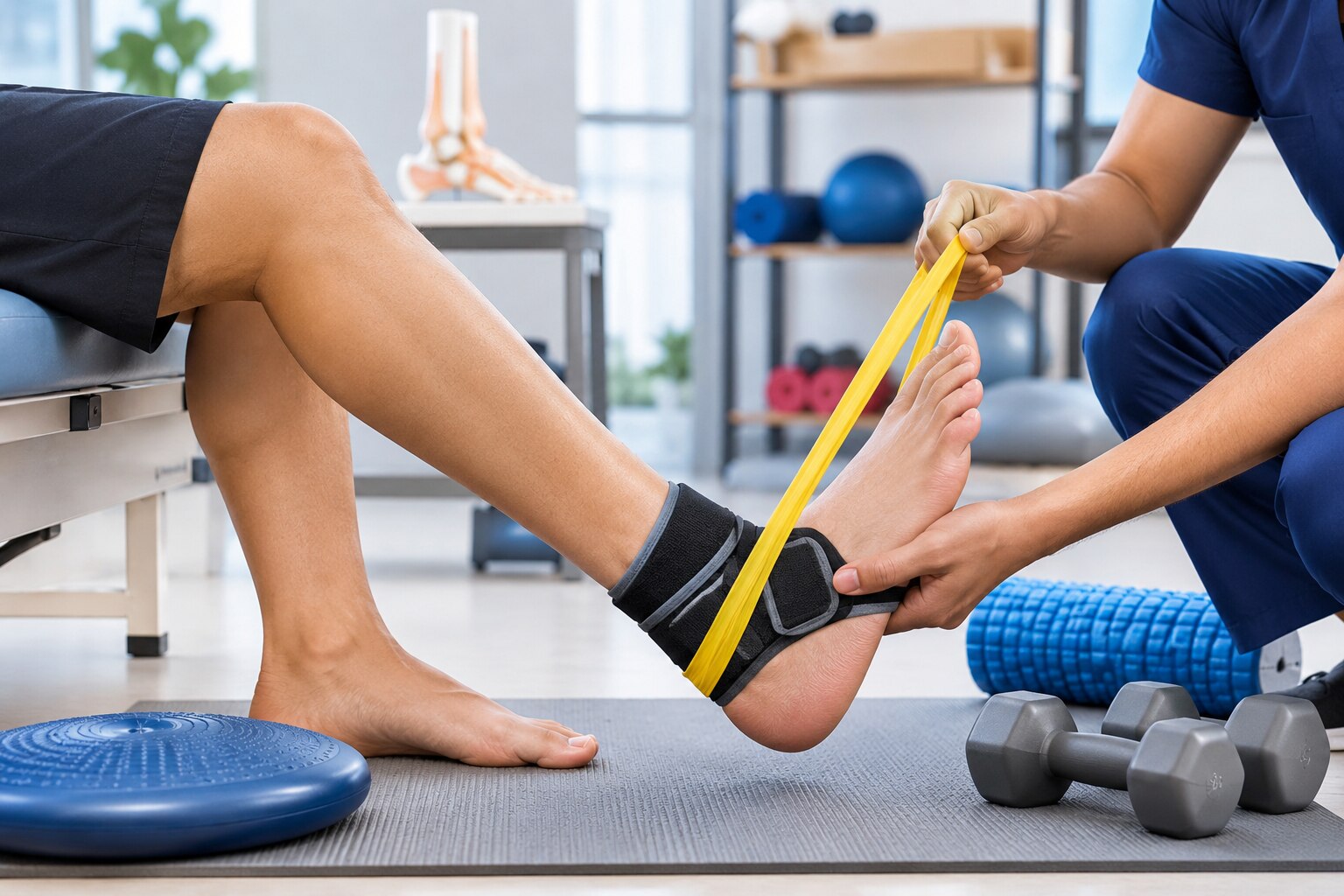
Strength and balance training rebuild ankle control by loading the calf and peroneal muscles, then challenging proprioception while you stand, reach, land, and change direction. Start with pain-limited isometric contractions or light band work; progress when swelling does not increase later that day.
- Use calf raises, first with both feet and then on one leg, to restore plantarflexion force and controlled lowering.
- Add resisted eversion for peroneal strengthening, then include resisted dorsiflexion and inversion so the ankle can respond in every direction.
- Practise single-leg balance near a support. Progress from a firm floor with eyes open to multidirectional reaches, head turns, a softer surface, reduced visual input, and sport-specific tasks.
| Exercise | Main control rebuilt | Useful progression |
|---|---|---|
| Seated band work | Directional ankle strength | Isometric holds to slow repetitions |
| Double-leg calf raise | Calf force and load tolerance | Greater range, then single-leg calf raises |
| Single-leg balance | Proprioception and stability | Reaches, unstable surface, reduced visual input |
| Lateral step-down | Hip, knee, and ankle alignment | Higher step and faster control |
A wobble or brief correction is expected; repeated giving-way, sharp pain, or rising swelling means reduce the challenge and seek assessment. Bracing during sport adds protection, but it cannot replace progressive strengthening and balance practice.
How to progress from standing to hopping, running, and cutting
Pain-free walking is only the entry point: it does not test rapid force, landing control, or an unexpected change of direction. Progress when swelling has settled, ankle movement is close to the other side, and single-leg tasks look controlled rather than guarded.
1. Build single-leg control. Add reaching in several directions and lateral step-downs without the knee collapsing or heel lifting. Calf raises should match the other side without pain, wobbling, or giving way.
2. Add hopping drills. Start with two-foot jumps, then single forward hops and side-to-side hops. Land quietly with good alignment, and check that pain or swelling has not increased later that day or the next morning.
3. Begin a running progression. Move from walk-jog intervals to continuous jogging, faster running, and acceleration. Increase one demand at a time; stop if your stride changes or confidence drops.
4. Test change-of-direction drills. Use shuffles and figure-of-eight runs before sharper cuts, deceleration, and sport-specific reactions. Readiness includes pain, ankle impairments, confidence, sensorimotor control, and functional performance—the five PAASS areas—not simply a pain-free walk.
Persistent giving-way, swelling, or stalled progress warrants reassessment. Manual therapy can improve short-term motion, but it does not replace progressive loading and neuromuscular training.
How long rehabilitation takes and when supervised care is worthwhile
Recovery is measured in weeks for a straightforward Grade I sprain recovery, but a partial ligament tear, repeated sprains, or persistent swelling can extend rehabilitation into months. Age, demanding sport, poor sleep, and inconsistent exercise also slow progress; adherence usually shortens it.
| Factor | Effect on timeline | When supervised care is worthwhile |
|---|---|---|
| Grade I sprain | Usually progresses over weeks | Advance when walking, balance, and strength improve |
| Partial ligament tear | Often requires months of graded loading | Test before running, jumping, or cutting |
| Recurrence or chronic ankle instability | Extends recovery and raises re-injury risk | Choose assessment instead of repeating home care |
| Swelling or giving-way | Delays movement and muscle control | Reassess when symptoms persist or function stalls |
| Older age or high-demand sport | Slows tissue tolerance or increases loading demands | Progress by testing, not the calendar |
| Poor adherence | Leaves strength and balance deficits | Simplify the programme and monitor sessions |
Self-management is reasonable when symptoms steadily improve and you regain motion, strength, and single-leg control. Choose professional assessment if pain, swelling, giving-way, or reduced function persists, or if progress stops. About 40% of people with a first-time lateral sprain developed chronic ankle instability within one year in prospective research.
PhysioFirstt can assess these deficits and decide whether an ankle brace and taping support sport while rehabilitation continues.
Related services
Sports Rehabilitation focuses on the prevention, assessment, treatment, and recovery of sports-related injuries. View service → |
Physiotherapy Physiotherapy Restore your strength, mobility, and quality of life with professional physiotherapy services tailored to your needs. |
How to prevent another sprain after the ankle feels better
Pain-free walking is not proof that the ankle is ready for every demand. Continue training single-leg control and responding to uneven surfaces, sudden loads, and changes of direction after daily symptoms disappear.
Use this maintenance routine:
1. Perform balance training two or three times weekly. Progress single-leg standing with reaches, an unstable surface, reduced visual input, and sport-specific movements. Stop if the ankle repeatedly gives way.
2. Keep calf raises, resisted eversion, lateral step-downs, and hopping in your programme. Strong calf and peroneal muscles help control landing and protect the ankle during rapid movement.
3. Build a warm-up into every run, match, or training session. Include ankle movements, brisk activity, calf raises, and practice of the movements your sport demands.
4. Use gradual training-load increases rather than adding distance, speed, jumps, and cutting work together. A sudden spike can overwhelm an ankle that feels normal during easy activity.
5. Check footwear and external support before higher-risk activity. Well-fitting shoes with suitable grip and a brace or tape can reduce hazardous ankle positions, especially if you have sprained it before. Support protects; it does not replace rehabilitation.
Get assessed if swelling returns, confidence remains low, or giving-way episodes continue.
Frequently asked questions
What does an ankle sprain damage?
Most inversion sprains damage the lateral ligaments, especially the anterior talofibular ligament; stronger injuries can also affect the calcaneofibular ligament. The grade influences protection, exercise selection and rehabilitation time.
How do you restore ankle movement after a sprain?
During the acute stage, manage pain and swelling while protecting the injury. Then use gradual ankle movement exercises within a comfortable range, followed by strengthening and balance work.
When can you progress from standing to hopping, running and cutting?
Progress when walking and single-leg standing are controlled and pain and swelling remain settled. Add hopping, running and cutting in stages rather than returning directly to sport.
How long does ankle sprain rehabilitation take?
Time depends on the ligament damage, symptoms, strength and functional control. Persistent pain, swelling, giving way or difficulty progressing makes supervised assessment worthwhile.
How can you prevent another ankle sprain?
Continue calf, peroneal and hip strengthening, single-leg balance and sport-specific drills after symptoms improve. Use a gradual return to cutting activities and consider external support when appropriate.