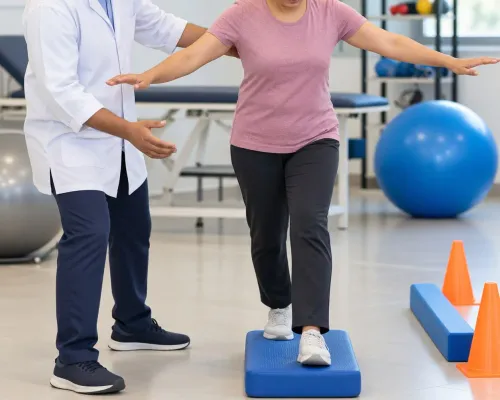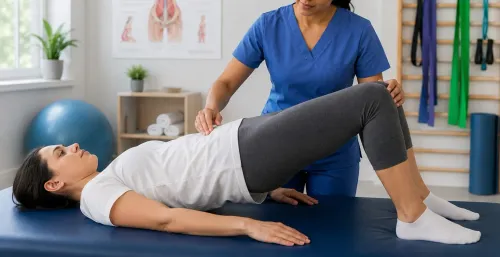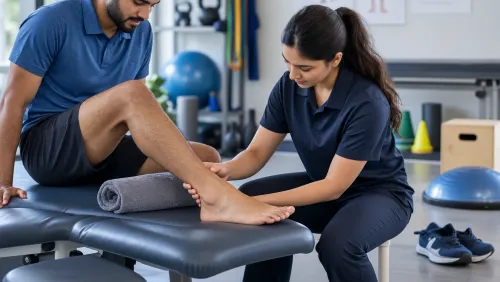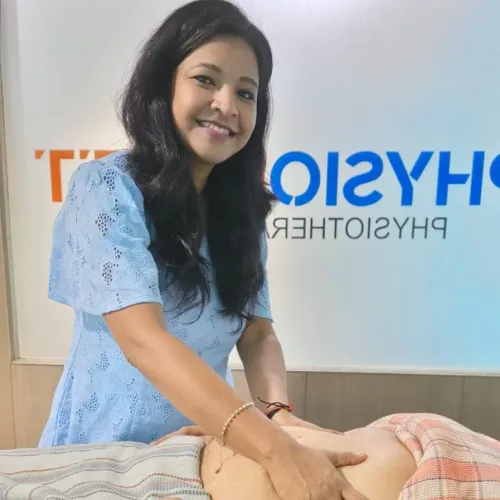
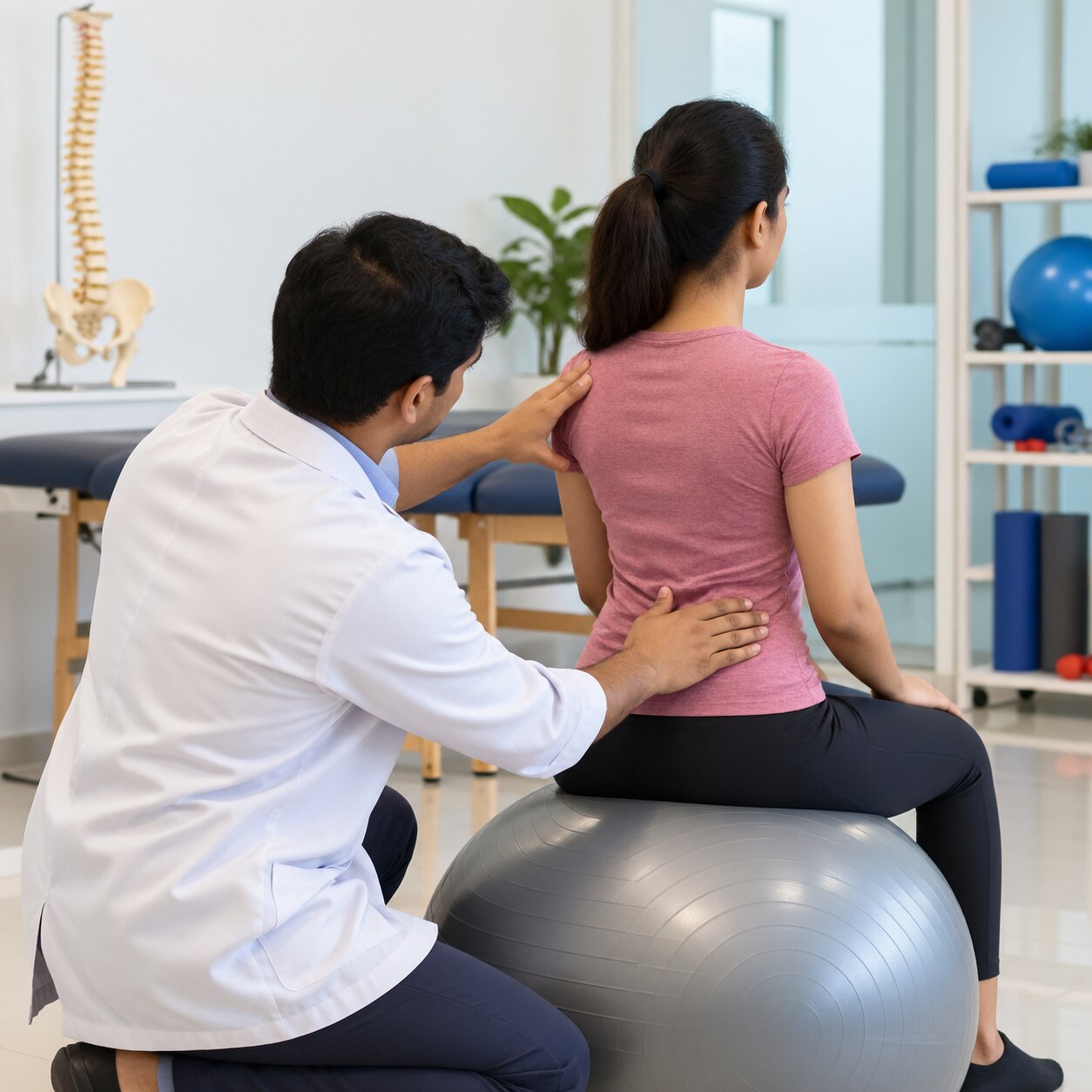
A slouched head, rounded shoulders, tilted pelvis, or uneven stance does not automatically mean your body is damaged or that one perfect position will solve pain. You will learn how physiotherapy assesses posture during real movement, which changes are worth practising, and how to build tolerance, strength, and control without forcing your body into rigidity.
Key takeaways
- Good posture changes as you breathe, balance, walk, and work.
- Assess movement patterns instead of treating asymmetry as the diagnosis.
- Change task setup and movement habits to reduce repeated strain.
- Build postural control with exercises that match your daily demands.
What Good Posture Alignment Looks Like in Real Movement
Good posture alignment is a flexible starting position that lets you breathe, balance, and move without unnecessary effort. It is not a pose you must hold all day, and a small asymmetry is not proof of injury or the cause of pain.
- Head and neck position: Keep your head balanced over your trunk, with your gaze level and your chin relaxed rather than pushed forward or tucked hard. Your neck should move freely when you walk, turn, reach, or look down.
- Shoulders: Let your shoulders rest wide and relaxed. Forcing them back can create upper-back tension; rounded shoulders are useful to address only when they restrict reaching, breathing, or comfortable activity.
- Rib cage and pelvis alignment: Allow the ribs to remain broadly stacked over the pelvis without flaring them forward or flattening your lower-back curve. You should still be able to expand your ribs and change position.
- Knees: Let your knees track in line with your second and third toes during standing, walking, squatting, and stepping. Do not lock them rigidly.
- Feet: Keep pressure distributed across the heel, base of the big toe, and base of the little toe. Your arches and toes should adapt to the ground rather than grip it.
A useful assessment watches standing, sitting, walking, squatting, and reaching, then compares comfort, control, range, and strength. The best position is the one that supports the task, not the one that looks most symmetrical in a photograph.
How Physiotherapy Finds the Cause Behind an Uneven Posture
A physiotherapist does not diagnose the cause from one photograph. They combine symptom behaviour, a standing and sitting assessment, joint range, muscle strength, coordination, sensation, reflexes and task performance in a dynamic posture assessment.
If you can change the position with a cue, fatigue, or a different activity, the pattern is more likely habitual or movement-related than fixed.
| Finding | What it suggests | How it is checked |
|---|---|---|
| Posture changes with a cue or repeated practice | Habitual alignment or a learned movement strategy | Compare relaxed and corrected positions |
| One side unloads during painful movement | Pain-driven guarding | Track symptoms during reaching, bending and loading |
| A joint will not reach a position, or strength fails under load | Restricted mobility or weakness | Test range, resisted movement and endurance |
| Unevenness remains across positions and does not correct actively | Structural difference | Compare leg length, pelvic level and spinal shape; assess structural scoliosis versus postural asymmetry |
| Poor balance, altered coordination, weakness, numbness or reflex changes | Possible neurological involvement | Perform a neurological screen and arrange medical assessment when indicated |
Walking and squatting analysis reveal whether the difference appears during weight transfer, balance or hip and ankle movement. At PhysioFirstt, asking about work, sport, sleep and symptom triggers helps connect the examination to the demands that reproduce the problem. New weakness, progressive numbness or bladder and bowel changes need medical assessment, not routine posture retraining.
Related services
Physiotherapy Physiotherapy Restore your strength, mobility, and quality of life with professional physiotherapy services tailored to your needs. |
Osteopathy Treatment Osteopathy is a safe, non-invasive, and holistic treatment that focuses on restoring the body's natural balance by improving the function of muscles,... View service → |
Daily Changes That Reduce Strain Without Chasing a Perfect Position
A desk setup should let you work without holding your body in one fixed shape. Set screen height so the top of the screen is near eye level and directly ahead; adjust chair position so your feet are supported, elbows rest near your sides, and the keyboard stays close.
Use desk ergonomics as a starting point, not a promise of pain prevention.
- Every 30–60 minutes, take standing breaks and move for two or three minutes. Walk, reach, or change position before stiffness builds. A sit–stand desk can reduce sitting time, but it is not a posture-correction device; movement variation matters more than holding a perfect standing position.
- While standing, keep weight spread between your feet, unlock your knees, and let your trunk settle instead of pulling your shoulders backward. Shift your weight and change stance when one position feels tiring.
- For lifting, move close to the load, bend through your hips and knees, keep the load near your body, and turn with your feet instead of twisting. Split the load when you must brace or hold your breath.
- Sleep in the position that allows easier breathing and less morning stiffness. A pillow between the knees can help side sleepers; supporting the knees can help back sleepers.
- Carry bags with two straps, switch sides, or use wheels for heavier loads. Persistent pain, numbness, weakness, or worsening night pain warrants assessment rather than more posture correction.
Exercises That Build Postural Control and Movement Capacity
Build capacity in layers rather than forcing your body into a fixed “correct” position. Start with movements you can perform without breath-holding or sharp pain, then increase range, repetitions, resistance, balance demands, speed, or time under load.
Useful training categories include:
- Deep neck flexor exercises to improve head-and-neck control and reduce overuse of superficial neck muscles.
- Thoracic mobility drills to make reaching, rotating, and upright sitting easier without pulling the shoulders rigidly backward.
- Scapular control exercises to coordinate the shoulder blades with the ribs during pushing, pulling, lifting, and overhead activity.
- Trunk endurance and hip strength work to support the pelvis and spine during standing, walking, bending, and carrying.
- Balance and single-leg exercises to improve control when your base of support changes.
- Task-specific practice, such as repeated lifting, reaching, or standing, to build tolerance for your actual work or sport.
| Category | Main capacity trained | Example focus |
|---|---|---|
| Deep neck flexor exercises | Cervical endurance and coordination | Gentle nodding while keeping the jaw relaxed |
| Thoracic mobility | Upper-back range and rotation | Extension over a support or controlled rotation |
| Scapular control | Shoulder-blade timing and strength | Wall slides, rows, or supported reaches |
| Trunk endurance and hip strength | Pelvic control and load tolerance | Bridges, side steps, carries, or sit-to-stands |
| Balance and task practice | Stability during activity | Single-leg stance, lifting, or reaching drills |
Motor-control work is not automatically better than strengthening or aerobic exercise for persistent back pain. Its value is giving you a tolerable route to practise movement and build capacity.
How Long Posture Retraining Takes and When to Stop
Start with a symptom-tolerable dose, then advance posture exercise progression one variable at a time: repetitions, resistance, range, balance challenge, speed, or task duration. Increase the demand only when the current level feels controlled and your symptoms return to their usual level by the next day.
Use pain and range-of-motion tracking twice a week. Record exercise difficulty, pain during and after activity, walking or sitting tolerance, and a simple movement measure such as how far you turn your neck or reach overhead. Improvement means easier movement, greater capacity, or fewer flare-ups—not necessarily a perfectly straight appearance.
Acceptable muscle soreness feels like a mild, familiar ache in the muscles used and settles with ordinary rest. Reduce the dose if pain becomes sharp, spreads, changes your movement, disrupts sleep, or remains worse beyond the following day.
Stop routine exercises and arrange medical assessment if you develop:
- New or worsening numbness, weakness, or radiating pain into an arm or leg
- Dizziness, fainting, severe headache, or loss of coordination during exercise
- Saddle numbness or bowel and bladder changes
- Fever, unexplained weight loss, or pain after major trauma
- Rapidly worsening pain or a sudden loss of movement
Seek urgent care for new bowel or bladder control problems, saddle numbness, or rapidly progressing weakness. A clinician can then check neurological signs and choose a safer plan.
Frequently asked questions
What does good posture alignment look like during movement?
Good alignment is a flexible starting position that supports breathing, balance, and efficient movement rather than a rigid pose held all day.
How does physiotherapy identify the cause of uneven posture?
A physiotherapist observes your posture, movement, strength, mobility, balance, and daily activities to identify factors contributing to the pattern.
What daily changes can reduce strain without maintaining a perfect posture?
Vary your position, adjust your workstation or task setup, take movement breaks, and avoid holding one posture for long periods.
Which exercises improve postural control and movement capacity?
Exercises that address your specific mobility, strength, balance, and coordination needs can improve control and support the movements you perform regularly.
How long does posture retraining take, and when should you stop?
Progress depends on the problem and your consistency. Stop an exercise that causes sharp or worsening pain and seek assessment if symptoms persist.
Related service
Sports Rehabilitation focuses on the prevention, assessment, treatment, and recovery of sports-related injuries. View service → |